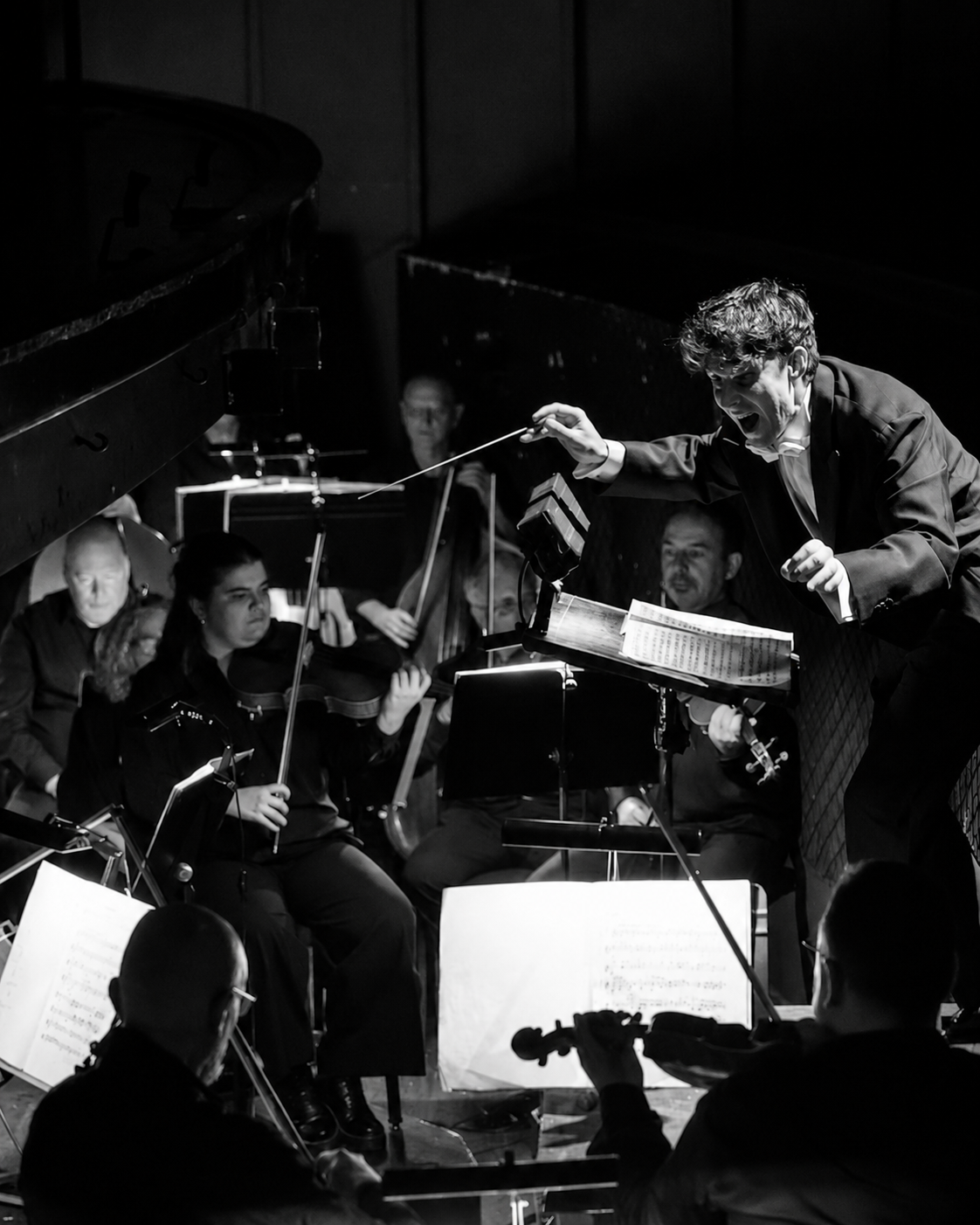
"The young Cádiz-born conductor raised the overall level thanks to a direction that was as energetic as it was nuanced, drawing spectacular results from the Orquestra Simfònica del Vallès, which seemed more finely tuned than ever. The choice of tempi, the attention to the smallest instrumental details, the ability to coordinate pit and stage, as well as an absolute command of the score demonstrated at all times, reveal a conductor of undeniable potential. It is not common to see someone so young conduct an opera like Norma with such authority and personality, both instrumentally and vocally."
"Without a doubt, Julio García Vico is a name to keep in mind for the years to come and an absolute success on the part of the new management of the FOC. Under his baton, the Cor Amics de l’Òpera de Sabadell, well prepared by Daniel Gil de Tejada, confirmed the remarkable progress shown in recent seasons, with the women’s section particularly outstanding."
"In the pit, Julio García-Vico lived up to the expectations raised by his youth, with a conducting gesture that conveys ideas—especially with his left hand—and evident energy and passion. A name to watch, without a doubt. He offered remarkable details, such as the suspended delicacy at the end of the overture—woodwinds and harp—driving the musical dramaturgy, highly attentive to the chorus and supportive of the soloists. The chorus responded solidly, particularly in the “War, war!” of the second act. The conductor sought nuance through agogic solutions intended to lend greater dramatic depth."
"Leading the Orquestra Simfònica del Vallès in these performances of Norma, he proved quite a revelation: the Cádiz-born Julio García-Vico delivered a surprising and exceptionally agile orchestral direction, marked by brisk, precise tempi already evident in the overture. He handled the dramatic pulse of the scenes that demanded it extremely well and was only somewhat hindered by the pauses required for set changes behind a lowered curtain. Had a scenic continuum been conceived, the conducting would have been brilliant from beginning to end. García-Vico remained constantly attentive to the soloists and the chorus, coordinated with a firm hand, and achieved a powerful volume without covering anyone—never an easy feat—while also bringing the orchestra to a boil in the most intense moments, such as the concluding trio of the first act, the warrior chorus, and the opera’s finale, crowned with the emotionally magnificent surge of the final climax.